Wooden Movable-Type Printing of China
Overview
Wooden movable-type printing is among the oldest printing techniques in the world, with its roots deeply embedded in the historical craftsmanship of China. This traditional printing method is particularly maintained in Rui'an county, Zhejiang province, where it plays a crucial role in the compilation and printing of clan genealogies. Its inclusion in the 2010 List of Intangible Cultural Heritage in Need of Urgent Safeguarding underscores its cultural significance and endangered status.
Historical Significance
Bi Sheng of the Northern Song Dynasty (960-1127) pioneered movable-type printing using clay characters, heralding the inception of this revolutionary technique. This breakthrough led to advancements in various types of movable types, including tin, wood, copper, and lead. Notably, wooden movable types emerged as particularly influential for future generations, second only to woodblock printing.
Wooden movable-type printing represents a significant achievement in the history of human communication and cultural transmission. Developed long before the advent of digital technology, this method revolutionized the way information could be duplicated and disseminated. Its invention in ancient China laid the groundwork for future advancements in printing technology, including the later development of metal movable-type printing by Johannes Gutenberg in Europe.
Technique and Process
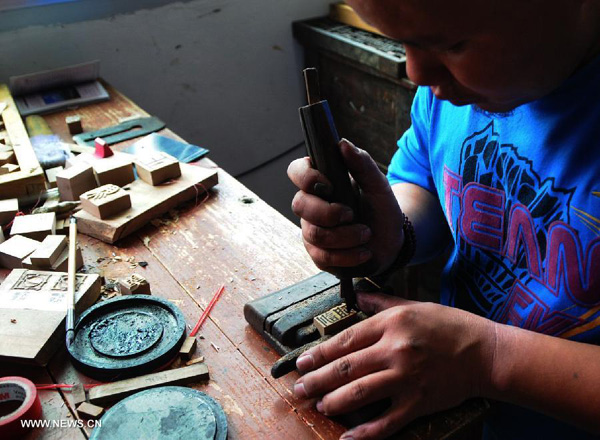
The technique involves crafting individual wooden blocks for each Chinese character. Skilled artisans, predominantly men, are trained to draw and expertly engrave these characters, which are then arranged to form a type-page for printing. The process calls for an extensive understanding of historical contexts and ancient Chinese grammar. After printing, women traditionally take on the roles of cutting the paper and binding it until the genealogies are complete. Once a type-page is dismantled, the movable characters can be reused for other projects, making it an efficient system for continuous printing tasks.
Modern Practices
In Rui'an county, the practice extends beyond mere printing; it embodies a communal cultural activity. Craftspeople carry their wooden characters and printing equipment to ancestral halls in local communities. There, they manually compile and print clan genealogies, a process culminating in a ceremonial event marking the genealogy's completion. These genealogies are then ceremoniously placed into a locked box for preservation, symbolizing the continuity of family lineage and heritage.
The skills required for wooden movable-type printing are traditionally transmitted through family lineages via oral teaching and practice. However, the craft faces numerous challenges in modern times. Intensive training, low financial returns, the widespread adoption of modern computer printing technologies, and the decreasing enthusiasm for compiling genealogies have led to a sharp decline in the number of practitioners.
Efforts to preserve wooden movable-type printing are critical, as the tradition teeters on the brink of extinction. The techniques have been recognized for their cultural importance, and initiatives are necessary to safeguard and revitalize this heritage. These include educational programs, cultural exhibitions, and potential integration with modern artistic expressions to attract a new generation of practitioners and enthusiasts. Article reference1. Wooden movable-type printing of China. chinadaily.com.cn. 20202. Wooden movable-type printing technique in SE China. chinadaily.com.cn. 2012Photo Gallery(5 pictures)CategoriesInvention and CreationTagAncient InventionIntangible Cultural Heritage of Humanity in ChinaIntangible Cultural HeritageCatalogue1. Overview2. Historical Significance3. Technique and Process4. Modern Practices- - - []








